Showing posts with label retail trends. Show all posts

Thursday, March 29, 2012

Best Buy Problems Signal Need for New Retail Formats

Best Buy StorefrontThe lower than expected earnings news announced by Best Buy March 29, 2012, show that the retailer is having trouble.  It said it would lay off 400 workers and close up to 50 stores.  On-line retailers, like Amazon, are eating into its sales; certainly, the continuing recession isn’t helping. The company chief executive, Brian Dunn,  conveyed growing frustration with consumers using Best Buy to merely touch and feel and learn about products, then turn and shop for the product on-line for better pricing.  Will Best Buy go the way of Circuit City and Comp USA - not to mention earlier closings of Crazy Eddie and Nobody Beats the Wiz?

Best Buy,the last standing electronics giant, competes in a declining market against on-line retailers with service and product knowledge.  Consumers complain that Best Buy is not doing great in these areas.  But non tech-savvy consumers do want to learn about products and handle them before buying.  It stands to reason that without brick and mortar retailers to provide this service, Amazon would suffer as well.

Another particular issue is that women generally do not shop at Best Buy. Only 16% of Best Buy shoppers are women, and 31% of its workers are female according to an earlier article in the Wall Street Journal.  While this is likely true of other electronic stores, it is not true for competitors, Amazon and Walmart. 

Is it time for another format for Best Buy?  Should retailing become “show-rooming” with retailers operating engaging product show rooms for consumers to touch and feel products and then allow low price shipping out of centralized warehouses to compete with Amazon pricing? I love how Apple, Sony and Bose storefronts work with greater emphasis on the customer experience.

It’s time for a new model for retailers like Best Buy.  I personally hope they can stay strong – where else will I kill an hour shopping (or should I say browsing) on the weekend?

Wednesday, March 30, 2011

Do Brands Suffer in a Recession?

Actually, no.  Recessions rarely have a direct impact on the strength of a brand. 

A brand’s strength is measured in its ability to maintain its identity in the eye of the consumer and how uniquely it delivers on its promise.  That is different than how much product gets sold. Certainly a business can suffer from slower sales due to consumers choosing not to purchase as many things, or even to purchase only at the lowest price, but a brand is measured in its strength of persuasion and loyalty.

Brands suffer when what they stand for is lost – usually to a competitor who is doing a better job of delivering on the promise. 

Here is an example.  A recent article on the beer industry shows that Coors Light beer is vying to take the #1 spot of beer sales away from Bud Light, which has seen its share decline for a couple of years.  While the market is declining –3% per year, Coors Light is seeing sales increases.  Bud Light is a well loved brand but has become somewhat interchangeable with others and has lost some its bond with its user.  Beer are measured by their consumer as to taste and how they fit in with lifestyle and friendships.  Coors Light has turned up the innovation (labels show when they are icy cold), and continued to hammer home with strong ad campaigns.

But these gains and losses in this category have little to do with a recession. A recession may cause consumers to act differently, usually by, more closely,  watching what they buy.  But the brand that stays relevant and tied to the consumer, in the end, will win.

Monday, February 14, 2011

Groupon Advertising Was Off Strategy First – Offensive Second

Companies, sometimes, overthink their messaging.  Groupon is a rather new on-line coupon service that is growing by leaps and bounds.  While they grow and have money to spend, what they need to do is to convince every mainstream mom in America to use their service.  While downloading coupons is not really new, Groupon needs to build massive brand recognition among a broad audience.  And what better place than a Super Bowl ad with over 100million viewers.

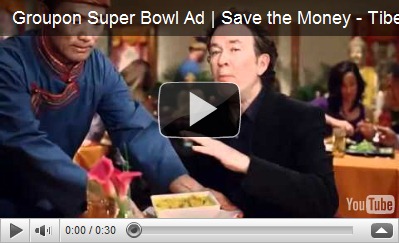
Groupon Super Bowl Ad
Crispin Porter & Bogusky created this ad, which was a bit irreverent in that it linked its money saving benefit to the plight of the Tibetan people who are being oppressed by the Chinese government.  What?? Well, actually it was intended to help build awareness to the plight of the Tibetan population. They might have been helped had they used their URL link to Savethemoney.org which was to bring donations to the Tibetan Fund.  But the advertising backfired, consumers did not get the humor, or the connection.  While Groupon’s sales did not decline (nor really grow either), the company’s CEO,  Andrew Mason, made the decision to pull the ads from further airing to minimize the negative exposure.  

Look, the reason to pull that advertising is simply because it was off strategy.  A simple lesson here is to stay true to the job at hand.  Groupon’s job is to become a household name, and it squandered its single largest exposure event trying to be outrageous and clearly overthinking what should have been a simple message and a huge opportunity. 

Friday, January 14, 2011

The Retailer Opportunity to Surprise and Delight

I received an iPhone this Christmas from my wife.  It was a wonderful gift. I really wanted it.  So much so, that I had already researched it online, compared all the other phones available, including prices, features and data plans.  So when I went in to get it (with my wife), the discussion went like this: “Can I help you?” asked the assistant.  “Yes” I said.  “I would like to purchase the iPhone 4”.  “Ok – do you have any questions” he asked.  “Not really, do you have any fun cases?”  “Over there”, he said.  He put the new phone on my existing plan and I left.  Actually my wife bought it for me, and I naturally gave her a big kiss and we both went on our way shopping for the kids. 

Ok, so there are no Jingle Bells in that Christmas story, but there is an implication. 

Shoppers are reaching a point where they have more information, and know more about products, than sales associates do. 
  1. Shoppers have online access to in-depth product information from manufacturers and comparisons across products from industry experts.
  2. Shoppers have access to all competitor pricing on their mobile phone in seconds.  If they have not checked the price before getting to the store, they can scan the UPC and check competitive prices immediately.
  3. Technology is now being tested to allow shoppers to see if a product is stocked at your targeted retailer or where the product is stocked.
shopping bagsOnline information will replace the assistance most retailers are equipped to provide.    Certainly some shoppers will want to be helped along the shopping process.  But the trend is moving strongly in that direction.  Smaller, independent retailers won’t survive long if they try to compete with mega stores that look more like a warehouse with a cash register.

NRF's Store Magazine has a great article on some of the ways that retailers can surprise and delight.  Some of the core themes:  Get online and become a player in the social media world, enabling mobile technology and Facebook to help break out of the pack.  Put the power of QSR codes into the store, allowing shoppers to find interesting video and product explanations.  In other words, participate --  don’t ignore the online world and the control that consumers now have over the content and selection.  Secondly, allow consumers to participate in product selections and give them exciting and surprising new ways to have a say in what their experience will be in that store.

Surprise and Delight and human experience.  While the traditional information tools that in-store assistance used to provide may be moving online, the ability to “surprise” and “delight” in a human way stay squarely with the retailer.