Showing posts with label marketing. Show all posts

Thursday, January 3, 2013

Survey Shows Top Tools For B2B Demand Generation

In the fall of 2012, we posted a link from our site to participate in a survey on demand generation tactics for B2B companies.   Software Advice published the results of the 2012 B2B Demand Generation Benchmark Survey.    While every business has unique approaches to building leads, these results are a great guide to what works best.

Tools generating the highest quality results for lead generation
B2B Marketers identified digital tools such as search engine advertising and search optimization as highest in quality along with 3rd party lead generators, in-house email and trade shows. 
B2B Demand Generation Quality Tools

Saturday, December 22, 2012

Avoid the “Hammer and Nail” Approach to Growing Your Business

hammer and nail marketingMarketing is a confusing topic to most small business owners. The process is not well understood.  Owners want more customers to buy more of what they provide – simple.  The word “marketing” itself is looked upon skeptically. 

Much confusion stems from the fact that communication tools are evolving at a rapid pace.  Social, digital and mobile platforms are taking the place of traditional selling and advertising. New subject matter experts promote magic bullet solutions to finding new customers.  Beware – if bad choices are made, lots of time and money can evaporate.

The Hammer and the Nail

When listening to advice from a marketing service provider, remember Maslow’s comment “to a person with a hammer,  every problem is a nail”.   Website designers pitch new websites as the best way to get more customers. Social media gurus suggest the latest social tools (Pinterest, Twitter, Facebook, etc.), and on it goes, leaving the small business owner confused and vulnerable, worried they are missing the boat entirely, because each expert sounds convincing.


Monday, December 3, 2012

Is Social Media More Effective for B2B Companies?

Many marketers have held the belief that social media is more effective for companies that sell to consumers (B2C) rather than to other businesses (B2B).  After all, B2B business is transacted by buyers and sales people who deal with complex bundles of product deliverables, pricing options and human relationships.

The opposite is actually true.  Social Media Marketing Report, a 2012 study, conducted by Social Media Examiner showed that B2B companies are using social media at a similar level to their B2C counterparts and, more importantly, are reporting stronger results.

Interestingly, this study shows that 56% of of B2B companies have gained new business partnerships using social media – a higher level than the 45% of consumer companies reporting new business partnerships.  B2Bs claimed greater marketplace insights (69% vs. 60%) and felt they get better search engine rankings (60% vs. 50% for B2C).  The one area that lagged significantly for the B2B companies was the development of loyal followers and fans (63% of B2C companies versus only 53% of B2B).

Tuesday, November 13, 2012

Finding Consumer Insights That Lead to Strong Brands

Great brands and compelling marketing campaigns are created when marketers uncover "insights" that reveal consumers’ true needs in a product category.  

Marketers may stumble onto an insight (most do) or find one after deep observation of consumer behaviors and motivating beliefs.  Once found, the path to building a unique and competitive brand is much clearer. 

Please take a moment and watch my short video on the differences between simple observation and uncovering powerful consumer insights:


Tuesday, September 18, 2012

5 Steps to Finding Growth Opportunities

Most companies participate in mature categories,from a growth standpoint. Fighting the category trend to grow the brand is difficult in a mature category. Uncovering growth opportunities will be done so in very different ways than opportunities for brands in a growth category.  

The careful balance and application of five marketing tools can provide success for a business. The visual below applies to both B2B or B2C corporations and highlights the five steps companies must consider for planning purposes: 5 steps to unlocking growth

Monday, August 13, 2012

A Consumer Insight Behind Social Networking

We often examine the marketing opportunities presented by social networks and social media.  But what do social networking habits say about consumers and all of us?  Are we seeking communities, friendships, and followers, or is something closer to real human nature at play?

As we face our drug-like addictions to checking twitter, texts and Facebook every few minutes during the day or night, we start to sense that there is a lot of "me" in "community" and being a friend is really an affirmation that we exist in the world.   Our obsession with social networks is really just another avenue with which to travel with the company of our own self-absorbed identity.

Tuesday, June 19, 2012

Carhartt – Smart Marketing in a Mature Category

image
Carhartt is a brand that has enjoyed a lot of success in the last several years, largely due to some smart brand positioning and activation. Rugged outdoor working apparel is a crowded category and certainly not in a strong growth mode. But Carhartt teaches an important lesson in leveraging consumer insight into a larger demographic group.

Tuesday, May 29, 2012

The Competencies Needed For Today’s Successful Marketing Team

marketing competencies teamMarketers have a lot on their plate these days.  The discipline itself is changing, driven by the CMO, who is challenged to bring a stronger business focus to marketing and ensure financial returns for the company’s investment. Marketers need to be more analytical, as more data is available to measure business results, while continuing to orchestrate all communications to customers, consumer and employees.

Building a successful marketing team requires a focus on individual competencies and skills.   Here are the six key competencies critical for today:  

Wednesday, May 23, 2012

Putting Loyalty Marketing First


My yearly subscription bill for my SiriusXM satellite radio came the other day. I had sticker shock - it was $250 for the year. I am sure the rate had gradually grown over time.   I probably didn’t pay much attention over the years, but am trying to pay more attention to credit card spending and bank statements. But I have only one player in my car. What happened? I thought this was the best deal in the world several years ago (before Sirius merged with XM) - and I am sure it was originally only $10 per month.
I immediately cancelled my subscription. I now play Pandora on my iPhone for free on my car stereo. Sirius called me and offered me a special incentive to come back - 6 months for $25 total. I said no. I now have free unlimited music.

Monday, May 21, 2012

The New Priorities of Today’s CMO

The position of Chief Marketing Officer (CMO) was created to elevate the responsibility of demand creation and branding to C-level status. It has been a short and rocky experiment so far. The average lifespan of a CMO is arguably less than 18 months. The VP Marketing-turned-CMO is often too rooted in tactical marketing terms that most CEOs don’t fully understand, like branding and engagement rather than revenue and cash flow. But today’s CMO is spreading his/her leadership wings; a change, largely, due to the internet.

Tuesday, May 1, 2012

Is the Yearly Marketing Plan Still Relevant?

CalendarBuilding the yearly Marketing Plan is a methodical, plodding process that is becoming out of step with the speed at which business planning is needed. The pace of change in digital communications and consumer conversations should be forcing marketers to question the current approach. This was even a topic at the South by Southwest (SXSW) conference, Marketing's Shift from Waterfall to Agile, in Austin in March 2012.

Friday, April 20, 2012

Three Marketing Lessons From Dick Clark

As someone who grew up with American Bandstand, Dick Clark’s daily TV music dance party, I feel a loss at the passing of this great legend. Dick Clark turned a generation of teenagers on to the latest music and launched many musicians’ careers.

clip_image002[4]While it might seem that Dick Clark’s fame is linked largely to an era gone by (alongside our love of The Beatles, the Jackson 5 and Chubby Checker), there are some timeless marketing lessons that can be taught from Clark’s brilliant career.

1. Host the party. Dick Clark brought us the fun, rather than creating the music. Products, tastes and fashions will change, but the person or brand that brings you the enduring benefit (in this case fun and dancing) stands forever. Dick Clark naturally went on to produce the American Music Awards, host syndicated top 40 countdowns, TV shows and is still known today for hosting our biggest party of the year - Rockin’ New Years Eve.

Thursday, April 5, 2012

Does Your Brand Have Personality?

Child SwimmingAll brands and businesses have a personality -- just like people. Consumers tend to gravitate towards brands that have personalities similar to their own, or at least their aspirational view of themselves. Personality is evident in the style and tone of all communication and interaction with the consumer – from the advertising, packaging, and social media to the sales person and customer service voice on the phone.

Brand Personality is defined as the application of human personality traits to a business or brand. There are said to be 5 main dimensions of brand personality (according to Investopedia  and based on work by JL AAker):

Excitement: carefree, spirited, youthful
Sincerity: genuine, kind, family-oriented, thoughtful
Ruggedness: rough, tough, outdoors, athletic
Competence: successful, accomplished, influential, a leader
Sophistication: elegant, prestigious, pretentious

Tuesday, March 20, 2012

The Moment of Change

Marketers should understand human behavior in order to be successful.  One of the best visual models I have come across is the “S-Curve”, which represents how people make decisions that involve change (like buying something they never bought before).   Decision points are the most efficient place to target a brand message – if they can be found. 

Consumer Decisions and “Pain”

  • All actions are preceded by decisions on which to act.   In marketing language, purchases (actions) follow decisions to purchase. 
  • Decisions to change are usually preceded by “pain” -- the realization that not moving forward will be far worse than doing nothing.  Seeking “pleasure” is another motivator for change, but a much weaker one.
  • People generally procrastinate when making decisions until the pain of not moving becomes severe.  Decisions to buy a new car, get married, remodel your kitchen are made with a LOT of pondering.  Even easy purchase decisions, like which cereal to buy, are pondered upon, and decisions are made after other options have been considered.
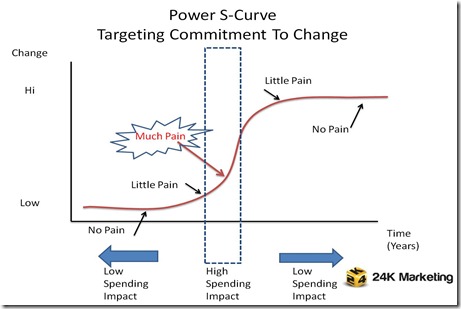
S-Curve

S-Curve and Marketing

The S-Curve represents the theory that decisions are made very quickly, but often after prolonged periods of awareness, without any action.  Pain is elevated by a triggering event.  A doctor’s diagnosis of heart disease, for example, is the point at which most people DECIDE (with real action to follow) to lose weight or quit smoking, even though they have considered this action for some time. Targeted communication at the point of pain (a doctor’s office) might do the trick.  Other money invested in communication is far less efficient. 

Marketers usually define the types of people who are most likely to have a need, and then blanket all of them with continuous messaging since it is hard to know when any of them may actually decide to do anything.  Much money is wasted talking to consumers who may be years away from pain.   

Use the S-Curve to determine the exact time and place of a real decision.  Be there with your brand message.  Find the moment of change.

Monday, March 5, 2012

Brands Struggle with Facebook – More Creativity Needed?

facebook eyeballI once ran a print ad campaign for a well known household cleaning brand in a declining category.  We believed it was well targeted, had a compelling message, and the creative was well done.  The results, however, were disappointing, with little awareness or sales conversion.  The marketers blamed the creative delivery; the ad creatives blamed the marketing strategy and low spending. In the end, we all agreed that print media just doesn’t “work” for the brand.  Now people are saying that Facebook ads don't work -- we are in the next generation of  the “Blame the media" game

Marketers are engaged in a passionate debate as to whether Facebook brand pages or advertising are effective tools for brands to use to communicate with consumers.  As Facebook gears up for its public offering and pushes out enhancements (timelines, etc.), the subject really heats up.

Fact 1 – There are over 500 million people on Facebook (1 out of every 13 people in the world).  250 million log on everyday.  71% of U.S. internet users are on Facebook. 

Wednesday, February 22, 2012

Smaller Portions Tap Growing Consumer Need

Food companies, in their effort to promote healthier eating habits, are tapping a growing consumer need for portion control – which might just get us to snack more often.    

SnickersMars, Inc., the maker of Snickers, Twix. M&M’s and many other tasty delights announced it will no longer sell candy bars that contain more than 250 calories by the end of 2013.  This means that some of its best sellers will slim down.  Snickers regular size will shrink from 280 calories to 250 calories, and the 540 calorie King Size version will be replaced with multi packs of smaller units.  Mars also announced it will trim its sodium levels in its products.

This move ties in nicely with Michelle Obama’s Partnership for a Healthier America initiative.  Sixteen of the biggest food manufacturers have signed on to reduce 1.5 trillion calories by the end of 2015 by reducing calories or portions, or both.  With 2/3 of Americans either obese or overweight, and childhood obesity on the rise, this move is needed.  

Monday, February 6, 2012

The Changing Role of Marketing

Business CommerceThe role of marketing is changing with marketers challenged to deliver on three new responsibilities:  

  1. Develop communication strategies to build consumer relationships and communities rather than one-way messages. 
  2. Develop tracking metrics to relationships, and uncover insights from a mass of raw data now available.  
  3. Understand the commercial profit and growth drivers of all aspects of the business, with stronger accountability to gain business results. 

These changes are separating the traditional marketing role into two roles - the business general manager, and the consumer relationship manager.  The speed at which these changes are taking place has marketers feeling unprepared in both areas. Traditional marketers lack the new media measurement skills and are also less familiar with the  commercial (non-marketing) drivers of the P&L.

Tuesday, January 31, 2012

Social Media – The 5 Questions to Ask Before Jumping In


social mediaSocial media’s development as a marketing tool for business has fundamentally changed the way businesses communicate with their consumers and customers. The pace of this change and the choices of tools and measurements are surprising most marketers. 

Most businesses have jumped into social media to some extent with very mixed results. The challenge they find is that building communities and fostering open dialogue takes a major commitment of time with few visible results. While it is much less expensive (in many cases free) for a business to post online, it can be a waste of time if not considered correctly.

Before beginning any social media marketing, it is important to answer the following five questions:

Friday, January 27, 2012

A Path to Finding Gold in New Markets

Some say that the grass always looks greener on the other side of the fence. Business leaders and marketers often wish to play in markets in which they don’t currently compete, or even create new markets, wistfully imagining themselves like pioneers in the wild west, scooping up incremental volume like gold from untouched streams in the hills of California. After all, spending years slugging it out in bloody battle for market share, well… anybody might do a little daydreaming.
At some point, most businesses will seek growth by looking carefully at their capabilities and entering a new market. This approach is often flawed, however. Organizations tend to think in terms of internal capabilities as success criteria – their brand, processes, distribution, speed, agility and entrepreneurial spirit. The secret to success, however, is in the honest assessment and understanding of the market being considered, and what is needed to solve an unmet need in the market.
There is a simple approach to examining a new market…..

Thursday, January 19, 2012

Marketing Seminars and Conferences – Should You Go or Just Say No?

imageAlmost every day, we receive emails announcing new seminars covering the latest marketing topics. Many times the quality and results are not in line with the investment in time or cost. Cost seems to have more to do with the newness and buzz around the topic, cost of the location and big name speakers and may be less correlated to the quality and resulting benefit to improvement in performance and skills.